The gradual erosion of aid
2023
Eurodad
In 2022, large parts of the global south were plunged into a complex and multi-layered emergency due to the polycrisis partially brought on by the Covid-19 pandemic, and compounded by the war in Ukraine. In that same year, Official Development Assistance (ODA, or aid) reached a new all-time-high of US$204 billion (a 13.6 per cent increase from the previous year).
Yet the truth behind these positive headline figures is that significant quantities of it never left the wealthy ‘donor’ countries thanks to the rules that govern aid. In reality, US$30.9 billion (or almost 15 per cent of total ODA) was reported against the cost of hosting refugees; against donations of surpluses of Covid-19 vaccine doses; and against debt relief. The reporting of these costs has inflated ODA budgets, while at the same time people across the global south have been receiving far less resources than they need to cope with the overlapping crises.
Furthermore, despite being more than 50 years since the 0.7 per cent commitment was made to the global south, ODA levels reached an average of just 0.36 per cent – the halfway point – for all countries that sit under the umbrella of the OECD Development Assistance Committee (DAC). Most DAC members are simply not fulfilling their 0.7 cent commitment – in 2022, only five met or exceeded this target: Denmark, Germany, Luxembourg, Norway and Sweden. Oxfam estimates that the failure of ‘donor’ countries in this regard has cost low- and middle-income countries US$6.5 trillion in undelivered aid between 1970 and 2021.
DAC members are also not adequately supporting the most fragile and poorest countries in the global south by failing to channel 0.15-0.20 per cent of their gross national income to least developed countries (LDCs) - a commitment reaffirmed in 2015 with the 2030 Agenda and the Addis Ababa Action Agenda. In 2022, only around 0.057 per cent of total ODA was channelled to LDCs.
It is becoming more likely that in 2025 the development community will gather for a new international conference on Financing for Development. On the road to this summit, DAC members must seriously assess if all of their aid flows are fit for purpose, and how much longer they want to continue failing to meet their commitments to the global south.
This article presents an overview of the main trends observed in the 2022 ODA preliminary figures released by the OECD DAC in April 2023. It argues that the inflation of ODA with costs that do not belong to it undermines the value of the aid statistics.
1. ODA volumes not as good as they seem
In 2022, aid reached the highest-ever levels recorded. Whereas the increase of aid in 2021 had largely been in response to the Covid-19 pandemic and collateral crises, this was not the case in 2022.
The invasion of Ukraine changed the playing field in many ways. On one hand, the increase of ODA figures in 2022 is partly explained by financial support delivered to Ukraine, which contributed 7.8 per cent of total ODA levels (equivalent to US$16.1 billion). Meanwhile, ODA supporting Covid-19 related activities went down to US$11.2 billion, a 45 per cent decrease from US$21.8 billion in 2021. This was in line with the improving situation in the health emergency. At the same time, DAC countries set a new record with ODA reported in 2022 through costs related to hosting refugees, which totalled US$29.3 billion (representing 14.4 per cent of the total ODA reported for the year). The previous record was set in 2016, against the backdrop of the war in Syria and related refugee crisis, totalling US$18.9 billion (11.6 per cent of total ODA). The EU countries in the DAC (20 in total, out of 32) alone have been responsible for 52 per cent of the total ODA reported in costs related to hosting refugees (equivalent to US$15.3 billion). In the case of the Czech Republic, Poland and Ireland, these costs represented more than 50 per cent of their total ODA levels in 2022.
The cost of hosting refugees through total ODA is so significant in some DAC countries, that if those costs were left out, the figures they would have reported compared to the previous year would have decreased. This has been the case for the Czech Republic, Denmark, Finland, Italy, Norway, Sweden, Switzerland and the UK.
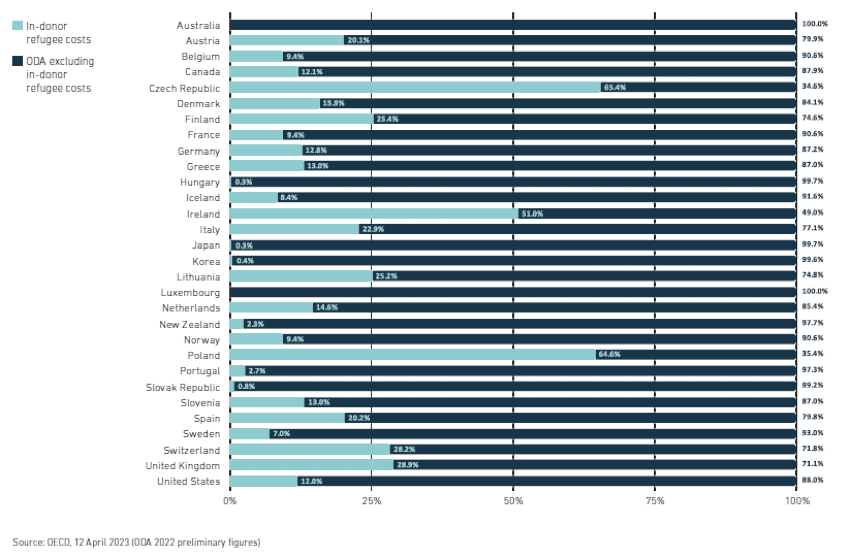
This trend is not likely to change in 2023, as the ONE Campaign estimates that US$ 31.56 billion of aid could be spent on hosting refugees.
In addition, despite the uproar of CSOs in previous years against this, the reporting as ODA of donations of surplus of Covid-19 vaccines to the global south continued. Vaccine donations reported as ODA amounted to a total of US$1.53 billion (or 0.8 per cent of total ODA) in 2022, of which $1.51 billion were surplus - or ‘left over’ doses. Doses bought specifically for developing countries accounted for a mere 1 per cent of the total donated in 2022. Although the numbers in surplus vaccine donations is low in 2022, the expectations from the CSO community were that DAC members would have dropped the reporting of these costs entirely.
In conclusion, in 2022, considerable amounts of ODA were actually diverted from where they were most needed to instead cover costs such as housing refugees in DAC donor countries or the donation of surplus Covid-19 vaccine doses. This is unacceptable, considering the critical role that ODA should be playing in eradicating poverty and inequalities and achieving the SDGs. For many countries across the global south, aid is one of the few options available for additional finance in their budgets, so that they can increase spending on public services and social programmes without increasing their fiscal deficit.
2. ODA 2022 preliminary figures are not the “real ODA” figures
Over the past 40 years, the OECD DAC has been establishing the rules for calculating ODA, amending them periodically. Some of these amendments have led to improvements in the quality of aid – for example the DAC Recommendation on Untying ODA. Others have effectively led to the erosion of the quality of ODA – for example, the reporting of debt relief in the grant equivalent system or allowing to report the donation of surplus vaccines as aid.
Current rules allow DAC donors to report against their ODA budget the following: an estimate of expenditure on refugees for their first year in the provider country; attributed student costs in the provider country; debt relief granted to creditors; and, since 2021, the surplus Covid-19 vaccine doses donated to ODA eligible developing countries and related costs (i.e. transport). However, none of these represent a transfer of funds to countries in the global south, but rather a diversion of funds from where they are most needed. Over the years, CSOs have raised concerns about the reporting of these costs as aid, as they do not fit the definition of ODA, which focuses on promoting the welfare of countries in the global south.
In 2022, the reporting of some of these costs has allowed DAC providers to inflate their ODA figures by US$30.9 billion (or almost 15 per cent of total ODA) with: i) US$29.3 billion reported as in-donor country refugee costs; ii) US$1.5 billion reported as donation of surpluses of Covid-19 vaccine doses, and iii) US$116 million reported as net debt relief. This represents an increase of ODA inflation compared to 2021 of 155 per cent (or US$18.8 billion).
The inflation of ODA undermines the value of the aid statistics. Currently, the figures officially presented provide a less and less robust picture of the resources received by countries in the global south to implement nationally determined development plans.
The concept of “real ODA” needs to be back into the public debate
The erosion of rules surrounding ODA is translating into decreasing aid levels reaching countries in the global south directly. In 2022, the high levels of aid masked the fact that a significant amount of it is not real aid and is not reaching the global south. In 2023, CSOs should join forces to put the concept of “real ODA” back into the public debate and hold DAC donors accountable on how they are delivering on their important historical commitments with the global south.
Furthermore, ahead of a new international conference on Financing for Development, possibly hosted by Spain, it is more important than ever that all development actors engage in a meaningful debate in which aid is redefined as reparations, from a colonial past, rather than charity. This would mean that the aid of the future would be focused on addressing the structures that have produced and continue to produce inequalities across the global south, and it would be based on social and economic justice.